
A conversation with Liars from 2010
The transgressive trio talk about outlasting the Brooklyn dance-punk scene, the fine line between accessible and experimental, and how the consumerist mindset ruined indie rock

Welcome to stübermania, where I dig into my box of dust-covered interview cassettes from the 1990s and 2000s (and crusty mp3 files from the 2010s) to present bygone conversations with your favourite alterna/indie semi-stars and the occasional classic-rock icon.
This is a newsletter in three parts: The Openers (links to recent writings, playlist updates, and/or other musical musings), The Headliner (your featured interview of the week), and Encores (random yet related links).
This is a free newsletter, but if you really like what you see, please consider a donation via paid subscription, or visit my PWYC tip jar!
THE OPENERS
Dust off those firewire and thunderbolt cables—last week in the Toronto Star, I wrote about how old iPods are becoming the new vinyl.
Last night at the Corktown in Hamilton, we were treated to another round of Mods vs. Rockers, 2026 style. In this corner, from Detroit, we have the punky power-pop of Mod Lang:
And in the other corner, the power-poppy punk of Ancient Shapes (a.k.a. Daniel Romano’s other Outfit):
Fortunately, we avoided a repeat of The Battle of Brighton; in fact, these two bands get along so famously, they’re doing a whole Ontario tour this weekend. If you go, be sure to hit up the merch table for Ancient Shapes’ “never to be digitized, never to be streamed” cassette-only/tour-only release, Disciplines, as well as Mod Lang’s excellent recently released debut, Borrowed Time, on which they more than earn the right to swipe their name from Big Star’s sassiest song. And with that, let’s get right into…
Notes on this week’s new additions to the stübermania 2026 jukebox:
Mod Lang, “Try Your Love”: Swoon-worthy jangle-pop drama for that teensy-weensy subset of Beatles fans who believe the Fab Four peaked with “Not a Second Time.”
Angine de Poitrine, “Mata Zyklek”: Sometime over the past two weeks, a magic switch was flipped and, suddenly, we now live in the world where a masked, stylishly spot-covered, performance-art prog-punk duo—call it polka-dot-core—from Quebec are le grand fromage of 2026 indie. The Saguenay group’s second EP, Vol. II, doesn’t drop until April, but ADP’s recent KEXP session is already approaching two million views, while a single resale ticket for their way-sold-out July 18 Mod Club show is going for more that what I paid for a pair of primo Nine Inch Nails tickets recently. (A second show was added earlier this week, but that too sold out in a millisecond, as did a third.) All the proof you need that math-rock is the new shoegaze.
Nothing, “cannibal world”: Actually, shoegaze is still very much the new shoegaze, although, with this single from a short history of decay (out today), Domenic Palermo looks beyond Loveless to drown in the dreamy drum ‘n’ bass of mbv.
cootie catcher, “Quarter note rock”: The Toronto quartet releases its third album, Something We All Got, today on Capark Records, and this is its most huggable highlight, a giddy fusion of off-the-cuff indie rock and scratch-tastic bedroom beat science that sounds like it could be a mislabeled Notwist or Shout Out Louds mp3 you snatched off Limewire in 2005.
Brigitte Calls Me Baby, “Slumber Party”: Answers the question, “what if Morrissey wrote ‘The Rat’?”
Listen to the complete stübermania 2026 playlist here:
THE HEADLINER:
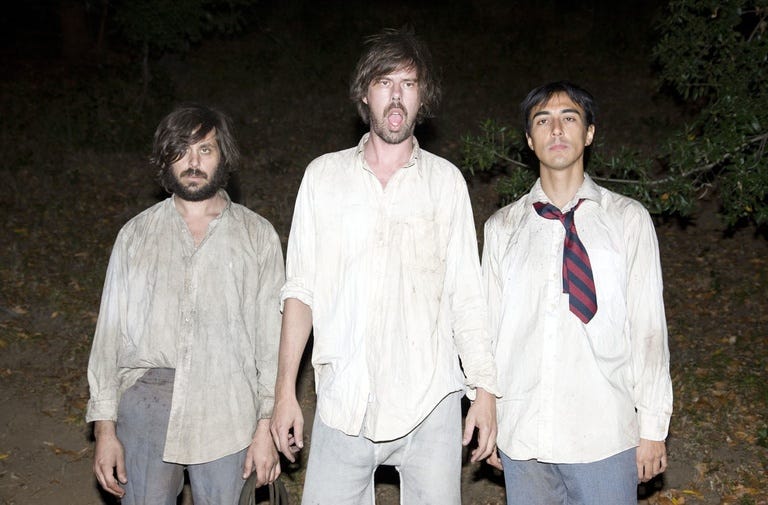
A conversation with Angus Andrew, Aaron Hemphill, and Julian Gross of Liars
The date: March 18, 2010
Publication: Eye Weekly
Location: The lobby bar of the Driskill Hotel in Austin, Texas
Album being promoted: Sisterworld
The context: This past week marked the 20th anniversary of Liars’ third album, Drum’s Not Dead, which completed the Brooklyn band’s transition from post-Y2K dance-punk trendsetters (and Meet in the Bathroom gossip fodder) to lawless avant-rock emissaries occupying their own rarefied space in the mid-2000s indie firmament. The album scored a 9.0 on Pitchfork and ushered in an imperial phase—marked by three consecutive Best New Music designations and Radiohead tour offers—where the band’s experimental and accessible impulses were perfectly in sync. The success of Drum’s Not Dead was especially sweet given that its predecessor, 2004’s weirdo witch-themed concept album They Were Wrong, So We Drowned, was infamously savaged by critics: SPIN deemed it “unlistenable” (and graded it an F), while Rolling Stone called it “a record you fear listening to” (and give it one star).
This interview with frontman Angus Andrew, multi-instrumentalist Aaron Hemphill, and drummer Julian Gross took place at the tail end of the group’s late-2000s hot streak, during the promotional campaign for their just-released fifth album, Sisterworld. We did a Thursday-morning meet-up South by Southwest, where they were set to headline a Friday-night showcase at Antone’s, and, befitting the band’s elevated status at the time, their label, Mute Records, set us up in the lobby bar of The Driskill, the historic (read: $$$) boutique hotel on the Sixth Street strip. Despite the relatively early hour, the guys were in good spirits, and eager to discuss their place in a music industry where the ground seemed to be shifting—both on a macro/corporate-tech level and micro/indie-culture level—on a daily basis.
Angus—you’re from Australia, you’ve lived in Berlin, you’re signed to Mute Records, you’re very tall, and your singing on Sisterworld goes very low. Are you trying to be Nick Cave?
Angus: No, I don’t think so. I guess it’s a new experiment for me, singing low. I don’t know, it’s difficult to avoid that [comparison] due to the similar background. I blame Mute more for that.
As much as the musical composition of Liars has changed, your voice has really changed, too. Was that a big breakthrough for you—realizing you could sing in falsetto and harmony?
Angus: Yeah… I just don’t know what’s right or what’s wrong. I read lots of reviews that say “it’s interesting because his voice is out of key, or purposely lacking in tune.” It’s just an experiment to see what happens. I like singing high and I like singing low, but I don’t know if one is more right.
Is doing something like “Protection” more a leap into the unknown than making something noisy and strange?
Angus: I think recently some of the songs we’ve been making have definitely been more introspective than ones before. The Drum’s Not Dead record and the Liars record both had a much more personal aspect to them, and it’s very frightening to write songs like that, especially after you’ve been working with abstraction. When you come straight down the line and say, “this is how I’m feeling,” that’s very frightening.
Aaron: It’s less about his barrage of clever allegory or metaphor that we’re constructing and more about communicating a feeling or situation, creating a scene that people can relate to. It requires Angus being very brave, to sing about something simple and that’s easily understood.
Julian: With this album in particular, we felt by and large the album was pretty tense, and troubled. So I think ending it with that song we chose leaves it more as a more open proposition, rather than it being this finished, complete exorcism of trouble.
It’s easy to see your previous records as reactions to each other, but this one feels like a natural extension of the last one.
Aaron: I think it’s not really a reaction to our work; we focus on our interests and try to express every side of it as best we can on every album, so the logical thing is when it sort of feels exhausted, so you move on. I feel like what we’re interested in now is a very broad source: traditional song structures and lyrics and vocals, and how to manipulate those boundaries.
Five albums in, is it easier to accomplish what you want to do, or is it more difficult in the sense of not wanting to repeat yourself?
Aaron: I think we make it difficult on ourselves, so it’s a good habit that we have, where the easy way is the one that seems most dubious.
Julian: The fun part of change is trying something different—like Angus was talking about trying to sing in a lower tone, just trying to challenge yourself to make it a little bit scary and make it more interesting for yourself and not stay too much in the same area, which becomes stagnant.
Having done something like the INXS cover with Beck, can you see yourselves trying to make a proper pop record?
Angus: To be honest, we’ve done that. That was Drum’s Not Dead. Honestly, I was so pissed at the reaction to that album—it was like, “these guys are so weird with their crazy concepts!” And I was like, “fuck, I just wrote the most normal song I could write on that record, and I was really trying to make it like that.” That’s the reality of where we’re at: What we think is really normal is still pretty weird for some other people. That means what you’ve got to do is then change your idea of what normal is, and go below that, and dumb it down. It’s a little scary when you start going down that road. The best way for us to deal with these sorts of things is to just challenge ourselves. In one way, after a record like this one, you feel like, well, we used some very traditional elements and, in a lot of ways, it’s a pretty traditional record—it feels like that quota is fulfilled. It feels like we’ve done something really interesting with strings and melody that I think we haven’t done before and to a certain extent that’s been exorcised. It’s time to go record garbage trucks again.
Aaron: For the most part, this has been the most traditional album, in terms of instrumentation. Some songs had parameters where it was like, drums/bass/guitar, no crazy effects—just notation and working with harmony and making that the quote-unquote effect. Anything we do, even if it’s simple, is going to be perceived in a very puzzling way, which isn’t a bad thing; hopefully it promotes investigation.
Angus: And the other quandary is, even though this could be one of our most traditional records, because of that, it therefore makes it our most experimental record, because of the way we come at it. It’s really abstract for us to think of it in those more traditional ways, and that’s what’s challenging at the moment.
Aaron, you and I did a phone interview back in 2004 around the time of They Were Wrong, So We Drowned, and the negative critical reaction that received. And at the time you lamented how indie-rock audiences had adopted the same conservative mindset as corporate-rock audiences. And now, in 2010, it feels like indie-rock is more conservative than ever.
Aaron: In hindsight, I wouldn’t dare any music journalist to say that’s such an experimental record. With the approach and the sensibility we had, it was an experimental record for us and our abilities, but it doesn’t sound half as controversial as I’d like it to be.
Angus: That’s right. That kind of gets annoying: If we really wanted to fuck it up, we’d fuck it up!
Aaron: There’s a portion of how our music is evaluated that really has more to do with other evaluations than a one-on-one confrontation between the listener and our music. And that’s acceptable.
I think They Were Wrong was saddled with a lot of expectations related to your involvement in the Brooklyn dance-punk scene. But you’ve really liberated yourself from that association.
Angus: That’s true. The expectations that we deal with now are idea-based… it’s really a quandary for us now, how much you reveal about what you’re thinking of when you make a record. People ask me what I’m thinking about when I make a record, and I tell them, and then suddenly that side of it becomes more important than the musical side. It seems to be the idea of making a quote-unquote concept record is now being swallowed more easily. It’s a great way to make a record, it’s a really interesting way to tie things together. I think people maybe are starting to appreciate that, especially because the album itself is dying, so it’s like, “how do you keep these songs important to each other, and not just on a playlist?”
Julian: That’s an important thing—it seems like records have turned into songs.
Pink Floyd sued their label for breaking up their albums and selling individual tracks on iTunes—though, if you read the comments sections on the news reports, you see a lot of people claiming it’s just a way to make fans pay for the whole album.
Aaron: You could say that, but what are you buying? You’re buying an album. Whether you like The Wall or not, and I’m not all too familiar with it, but I do know that Pink Floyd attempted to execute a piece of art. But how that thought enters a music fan’s mind—that it’s an immediate consumer ploy to get you to buy the entire album and to overlook the fact that maybe they intended it to be this singular piece of art—that troubles me. Because it suddenly becomes all about consumer advocacy rather than listening to it how it was intended. And I think if you’re going to take the line of thinking that it’s just a ploy to get you to spend more, it’s your responsibility to accept the fact that you listen to music like a consumer buys a product, not like a person views a painting. And your disappointments are more in line with consumer-based faulty issues rather than “I don’t get the painting, can I get my money back.”
It’s like wanting to buy only the car-chase scene from a movie.
Aaron: And I think it’s kind of strange. My biggest fear is that the same sort of mentality is going to be translated to live events. Pretty soon, I wouldn’t be surprised if people start asking for their money back if I break a string.
Angus: Or there’s that thing where you have to play your full record in order.
Aaron: The programming of what to expect… not only are you not going into a live experience where anything can happen, you have a preexisting recording to evaluate that against.
Julian: It’s this idea of low-attention span and immediacy and knowing everything that you’re getting, instead of letting things develop. Everything has to be quick—if you don’t like it in 20 seconds, you move onto the next song.
Aaron: And what that falls more in line with is, back in the ‘80s, say, there were people who bought Whitney Houston cassettes because they knew there were five hits on there—they were getting their money’s worth. That’s a different mentality than my brother, who bought the Christian Death bootleg even though it sounded like shit. More and more, quote-unquote independent rock is taking on an extremely corporate way of ingesting the music, and evaluating it on a consumer-product level rather than on an art level.
Julian: It’s interesting how when Pink Floyd wants to do this, people look at it as, “oh, they just want more money.” Not that they’re saying, “don’t give me your money if you don’t want the whole record.” It could go both ways—they could be losing just as much money by telling people they can’t just buy “Mother.” [Consumers] don’t look at it as integrity or art, they look at it as some new form of capitalist thing to spend more money on Pink Floyd. The technology is ruling the argument, because digital music made it possible to skip through tracks.
Angus: So then the onus just comes back on us to make a record that’s worth listening to all the way through.
ENCORES
With regards to the iPod-revival article linked at the top of this newsletter (and here again to save you the upward scroll), Liars were the ultimate iPod-era band for me, a cornerstone of my listening habits circa 2002-2012. In fact, I can actually pinpoint the moment my interest started waning to the advent of streaming. Liars’ seventh album, Mess, came out in 2014 around the time I first got a Spotify account, and I swiftly added the record to my library, but I didn’t enjoy the experience of bouncing between iTunes (to listen to my existing collection) and Spotify (to hear new arrivals). When Apple Music launched a year later, it let you integrate your old iTunes library with new streamable releases, so that became my default service, and given that Mess hadn’t grabbed me to the same degree as Liars’ previous releases, I never bothered adding it to my Apple Music collection. And then I just naturally lost track of Liars in the ensuing years, as the core trio splintered and it effectively became Angus’ solo project. One of the strange/sad byproducts of the streaming era’s endless over-abundance is that bands whose albums used to constitute major events in my life barely register as a blip now—I’m ashamed to admit I still haven’t gotten around to listening to TFCF or The Apple Drop. But I do remember digging Angus’ cameo on the quasi-title track to Holy Fuck’s 2020 album, Deleter:
While I’ve talked about Drums Not Dead and Sisterworld as the bookends of Liars’ late-2000s peak era, my favourite album of theirs remains the one in the middle—2007’s self-titled release—which features the best Jesus and Mary Chain homage by a weirdo noise act this side of Butthole Surfers’ psychocandied remake of “Something” on pioughd.
One last thing: if you’re planning to hit South by Southwest this year, a room at The Driskill will now cost you between $770-$883 U.S. per night.
This is a free newsletter, but if you really like what you see, please consider a donation via paid subscription, or visit my PWYC tip jar!
That Whitney Houston/Christian Death line is hilarious.
Also, ballsy opening question, Stuart!
And a soupçon of The Bravery on that great Brigitte Calls Me Baby track?