
A conversation with Nick Valensi of The Strokes from 2001, and one with Fab Moretti from 2006
I spoke to the future New York rock icons when they were still in their "we just put out our first EP" phase—and then a few years later during the "dating Drew Barrymore" phase

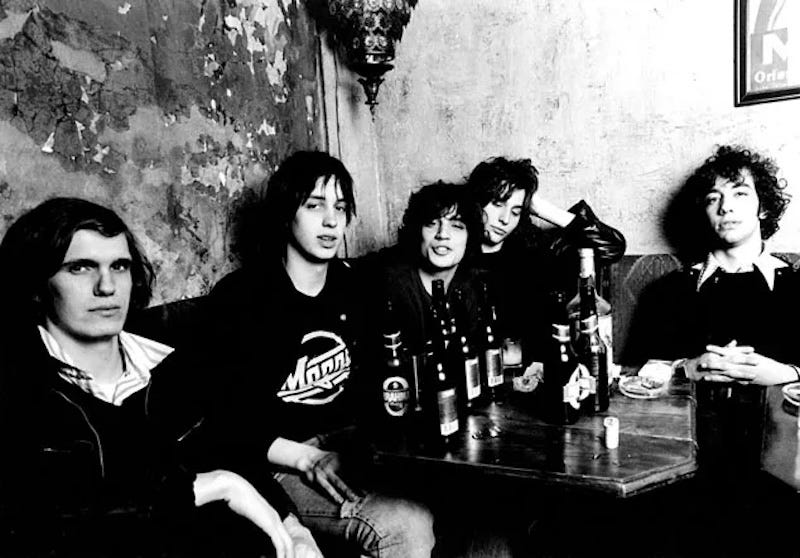
Welcome to stübermania, where I usually dig into my box of dust-covered interview cassettes from the 1990s and 2000s (and crusty mp3 files from the 2010s) to present bygone conversations with your favourite alterna/indie semi-stars and the occasional classic-rock icon. (Check out my archive featuring 100+ interviews here.) But occasionally I’ll use this space for other kinds of writing as well.
This is a newsletter in three parts: The Openers (links to recent writings, playlist updates, and/or other musical musings), The Headliner (your main feature of the week), and Encores (random but related links).
This is a free newsletter, but if you really like what you see, please consider a donation via paid subscription, or visit my PWYC tip jar!
THE OPENERS
I need to keep The Openers section brief this week, and also let you know this newsletter will be on pause for a minute while I tend to an unexpected life disruption, but I hope to be back in your inbox soon. In the meantime, you can celebrate today’s 25th anniversary of Is This It (UK release, at least) with this double-shot of Strokes chatter:
THE HEADLINER #1
A conversation with Nick Valensi of The Strokes
The date: February 21, 2001
Publication: Eye Weekly
Location: I was at the Eye Weekly office; Nick was in New York City
Album being promoted: The Modern Age EP
The context: In a previous edition of this newsletter, I detailed my first encounter with The Strokes, when they opened for Guided by Voices at New York’s Bowery Ballroom in February 2001. And upon my return home, I was delighted to discover they would be playing their first Toronto show a few weeks later opening for Doves at the Opera House. So I emailed the PR company they had just hired, Big Hassle Media, and put in a request to do an advance interview for Eye Weekly. I was given a date and time to call a recording studio they were working at, and I was told to ask for Julian Casablancas… who answered the phone, but after I introduced myself, he mumbled something indecipherable, as if I had just woken him from a nap, and then he handed the phone off to someone else who took over the call with a mock-professional-manager tone apologizing for Julian’s sudden unavailability. I wasn’t sure if I was being pranked, but then the person introduced themselves as Nick Valensi and he offered to answer any questions I might have.
Our phone call was relatively brief—at the time of this conversation, there was still very little information I could find about the the band beyond a short profile in the NME; they had only officially released three songs; and they weren’t exactly a band that came to the table with grandiose ideas of what they wanted to achieve in music. They were just five pals knocking out tunes that sounded good to them. As the resultant article reprinted below affirms, at this point in their trajectory, my best bet was that The Strokes could become a slightly more popular version of The Mooney Suzuki rather than a generation-defining band.
I’m pretty sure this was the first article on The Strokes ever published in a Canadian media outlet—and possibly the last time they serviced media with this goofy press photo:
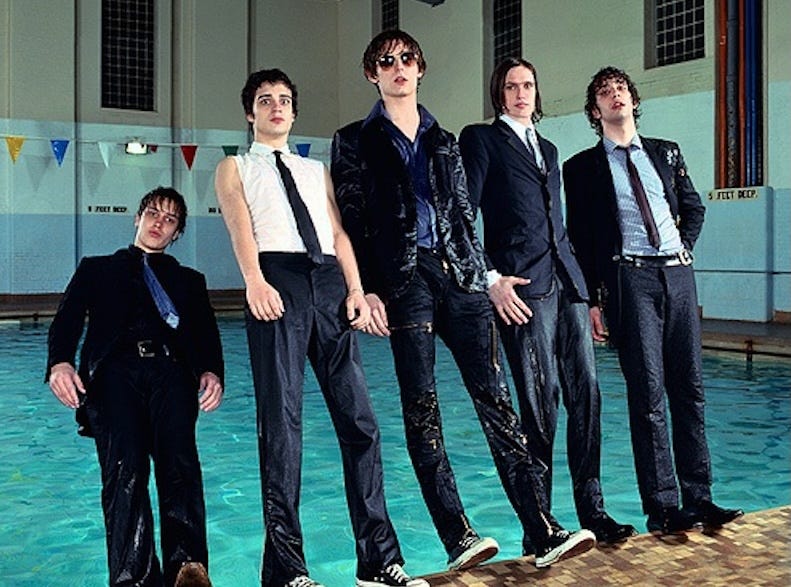
From the March 1, 2001 edition of Eye Weekly:
It used to be that mentioning the words “strokes” and “New York City” in the same breath produced visions of old men doin’ the Pee Wee Herman in less-than-reputable Times Square cinematic facilities. But in the post-Giuliani era, strokin’ in N.Y.C. has taken on a whole ‘nother meaning, though the actions involved are no less seedy. Riding a locomotive rhythm on a secret VUnderground subway track that leads straight from CBGB’s to Max’s Kansas City; exuding the faux-fraternal, last-gang-in-town attitude of da Ramones; flying high on that Feelies feeling; and sporting a pin-up-ready look that recalls the just-got-outta-bed thrift-store cool of Television, the Strokes couldn’t be more New York even if they were wearing Yankee pinstripes.
Like their East Village homeboys the Mooney Suzuki, the Strokes have pulled off the near-impossible task of getting nattering, blasé SoHo hipsters to shut the fuck up and live a little by dancing a whole lot. The number of instant converts is currently matched only by the band’s record-company business-card collection, and A Hard Day’s Night-style scenes of being chased down the Bowery by schoolgirls seem inevitable. And like their class-of-’76 forefathers, the Strokes have parlayed cult notoriety at home into cause-célèbre status in the U.K. All right, so what’s the freakin’ big deal?
“Shit, we didn’t have any plans to begin with, we just sort of played it by ear,” observes guitarist Nick Valensi, who’s been handed the phone and interview duties by “incapacitated” vocalist Julian Casablancas. “It’s been such a gradual thing—at our first show there were, like, six people, all friends of ours, and then at our next show there’s 20, and it’s just been little by little. With word of mouth, it just started getting bigger. Then we were selling out places like the Mercury Lounge and it just happened, really… I don’t know how it happened.”
Anyone looking for a straight answer need only spin the Strokes’ debut three-song single The Modern Age (Rough Trade), perhaps the first disc to make me hit the Repeat button in 15 years of CD-player ownership. The charms are undeniable: Fab Moretti’s rock-steady shuffle-stomp backbeat, Nikolai Fraiture’s bouncing basslines, Valensi’s and Albert Hammond Jr.’s smooth-as-Sterling six-string entanglements, and Casablancas’ Lou-lovin’ delivery, which combines mean-street cockiness and suburban innocence in a way that only a lad who just passed the minimum New York State drinking-age requirement can muster. But as blessed as the Strokes may be, Valensi insists the band’s procession of instant pop classics is more a product of long hours and long-standing relationships than any sort of immaculate conception.
“The five of us have been together as the Strokes about a year and a half, but we were friends way before we played music. Music isn’t the only thing that holds us together. When I’m not playing, I hang out with these guys; they’re my best friends—I got no one else, really. There’s no other way to do it. I couldn’t imagine playing in a band with people who I met through a newspaper ad.
“We took a solid six to eight months practising the songs Julian was writing. We work really hard on our songs and there’s this constant progression. We’ve got a motto in the band: ‘Our next song has to be better and different and newer and fresher-sounding than our last song.’”
With new Strokes material being met with greater anticipation than fresh rocks in a crack house, the band is currently in the studio with Pixies producer Gil Norton, finishing off a second three-song single set for an April U.K. release. Valensi’s keeping coy on the details (“It’s hard to explain... it’ll probably be called ‘Hard to Explain’”), but expect the band to chuck its checklist of N.Y.C. rock references—which they claim they never referred to it much in the first place.
“Julian writes most of the songs and I know he doesn’t listen to New York City bands,” Valensi says. “We love the Velvet Underground, but bands like Television, Blondie and the Ramones aren’t the kind of thing we listen to. We don’t listen to much new stuff either—it’s more stuff like John Lennon, the Beach Boys and, sure, the Velvet Underground. But people write articles like, ‘These guys listen to Television,’ and it’s weird, because it’s not what we listen to at all. I listen to a lot of Bob Marley, actually.”
THE HEADLINER #2:
A conversation with Fab Moretti of The Strokes
The date: April 26, 2006
Publication: Eye Weekly
Location: I was at the Eye Weekly office; Fab was calling from somewhere between New York and Washington DC.
Album being promoted: First Impressions of Earth
After The Strokes finished their aforementioned opening set for Doves at the Opera House in March 2001, I was hanging out on the venue’s balcony, which had a front-row seating area generally reserved for working media and other guest-list recipients. Before Doves took the stage, The Strokes entered the area to watch their set, and I found myself sitting next to drummer Fab Moretti, who turned to me, and asked, “excuse me, sir, did you happen to catch the opening band’s set?” And I replied, totally deadpan, “yeah—and they sucked.” Fortunately, Fab quickly realized I was joking and we shared a laugh and exchanged some friendly small talk about seeing them in New York and interviewing Nick. But then his face suddenly turned serious and he asked: “Did you see me throw my drumsticks into the crowd at the end? I think I might’ve hit someone—did anyone get hurt?” Dude was genuinely worried that he had poked somebody’s eye out. But I assured him that no one ran screaming out of the pit and no parademics were called in. He breathed a sigh of relief, and was able to enjoy the rest of the Doves show.
All of which is to say is that Fab seemed like a real mensch, and I was happy to learn that, when I got to speak to him for an Eye Weekly interview five years later, he was still pretty much the same affable gent I briefly interacted with that night at the Opera House—even as he was playing arenas, dating Drew Barrymore, and achieving that level of success where interviews are limited by publicists to tightly regimented 10-minute phoners.
So I got to interview Nick around the time of the first EP, and he talked about how focused the band was at the time in terms of writing new songs. But, now after all these years of touring and all the media hype, has it become more difficult to get into that songwriting zone?
No, I think it’s easier for us to force ourselves into some weird headspace now. I guess if we were 100 percent objective, it would be difficult. But we’re kind of delusional a little bit.
Coming into First Impressions, were you feeling confined by the idea of what a Strokes is supposed to sound like?
Yeah, we were trying to stick a flag on the ground saying, “this is the country of Strokes.” And now we’ve started expanding: we’ve got counties and little towns, we’ve got some really big metropolitan cities now! I think we’ve just adopted this mindset of… we’ve been on the road enough and met enough inspiring people that we realize that trying to do what you think is right from the heart doesn’t necessarily mean doing it the same way every time.
Is it a relief now that the press seems to have moved onto hyping bands like Arctic Monkeys, and you can just have a more normal band existence?
Yeah, I feel that people have accepted us as a band, and that we’re not just a flash in the pan. Some people like the record, some people dislike it…
It’s almost like you’ve reached that Pearl Jam post-hype zone where you can do whatever you want, and be confident that enough people will stick around to see where you go next.
Yeah, that’s a pretty nice way to be. The new stuff is getting a better reaction than the old stuff [at our shows]. It’s really rewarding to finally get the song right onstage and feel a certain acceptance from the crowd.
Do you ever think: “If only we had recorded Julian’s vocals on ‘The Modern Age,’ a little differently, we could’ve spared ourselves a lot of Velvet Underground/New York punk comparisons?
Yes, definitely. I agree with you on that one.
So what sort of headspace were you trying to get into with this new record?
There’s just a whole rainbow of music styles—we looked to some artists for their lyrical content, some artists for their rhythm, some bands for their guitar-work… we’ve got a lot of influences.
It really feels like you’ve shaken off the “garage rock” tag and went for the Big Rock Album experience. Having done that now, can you see yourselves going further in that direction, or is each album a blank-slate experiment?
Definitely man! It’s no fun if you stay in one room. It’s nice to travel around the house and visit the library. This album was made for the bathroom… no, this album was made for the kitchen. Wait till we get to the bedroom, boy!
I’m curious how you feel about Room on Fire in retrospect—even though it had the impossible task of following up Is This It, I feel like that album has held up really well on its own.
Thank you for saying that, I really appreciate that. I agree: It’s the kind of record where, if we do things right and we make good music that people appreciate in the future, I think they’re going to come back to Room on Fire. It’ll be like Mother’s Milk by the Red Hot Chili Peppers. That wasn’t a huge album, but after everybody got Blood Sugar Sex Magik, they went back to Mother’s Milk and said, ‘Oh, there’s some great songs on there.”
So we’re coming up on the fifth anniversary of Is This It—which means we’re also approaching the fifth anniversary of 9/11. That must’ve been such a strange time for you guys… you had all this momentum going into your first record, and then this horrible disaster strikes. It’s like all your rock ‘n’ roll dreams were coming true in the middle of a national nightmare. How were you feeling as all that was happening?
That’s a difficult question to answer; it was such a freaky time all around. On that day, we were all so fucking freaked out to hang out with each other. It’s funny, because I was just talking about this with someone just recently—we hadn’t really remembered our personal experiences of 9/11 in a long time, we never retold our own stories, because there was such loss on that day. When time passes, you look back and you’re like, “man, that’s freaked out!” I think that our role on 9/11, during that time, went from being this band from New York City that dresses a certain way—which I hated—to, like, “wow, check it out—a band from New York City.” We assumed the responsibility of taking people’s thoughts away from tragedy ,for however much time we could. And, looking back, I’m proud of that, and grateful for that… does that sound like a dickhead thing to say? If we could entertain people to get their heads away from tragedy and loss, then so be it. We’re happy to do that. I felt like [music] really did matter at that time. Whenever something really bad happens in the world—like, you hear shit about war and the environment—I always think of my friends and family in other parts of the world and try to assemble a sense of community, so I feel a closeness even to things that are far beyond me. And we hopefully could be that to some people—when certain shit happens, people can think, “Hey, the Strokes are out there playing their music.”
You’re in a band that gets written about a lot in music magazines. And now you’re in a relationship that’s put you at that People magazine level of attention. Do you ever get a break from media scrutiny?
Yeah—luckily, I’m in a band that walks like a robot, and each limb is a different band member, and without one of those limbs, the robot wouldn’t function. If one step has to be made, we all have to shift accordingly. We actually don’t get individual media attention. It’s like a drop of ink in a bathtub. I can’t imagine doing this as a singular pop star. And my girlfriend, she’s the one that gets the media attention and I gladly bow out of those situations, because she deserves it and she knows how to handle it much better than I do. I don’t care that some old lady in Tucson, Arizona knows, or doesn’t even care, who I am—they’ve just seen my picture. I’m much happier when I see the kid outside of our gig waiting for Nikolai to come out, because he’s got all four of our signatures, and he needs Nikolai’s to complete the set.
ENCORES
Last year, I published this interview with Doves’ Jimi Goodwin where he talked about taking The Strokes out on their first proper tour, and getting leapfrogged by them on the hype train.
Here’s my original 4 (out of 5) star review of Is This It that ran in the September 27, 2001 issue of Eye Weekly—which was a little more tempered in its praise than I remember, though I stand by assertion that the original EP version of “The Modern Age” blows the album version out of the water.
So this is it. After striking the Velvets gold mine with their debut three-song single “The Modern Age” and the fantastic follow-up “Hard to Explain,” the new popes of Greenwich Village are making an inaugural full-length bid to join their hometown heroes in the annals of N.Y.C. immortality. But by making it look so easy, the Strokes have made it awfully hard on themselves: with the exorbitant expectations surrounding the release of Is This It, anything less momentous than Meet the Beatles, The Velvet Underground & Nico and Ramones combined simply will not do.
Well, in that regard, they blew it. The production’s too tinny, I don’t know what the hell they were thinking when they decided to slow down and re-record “The Modern Age,” and I’m not sure if they needed to rework “Barely Legal.” But if these are the Strokes’ biggest problems at this point in the game... well, let’s just say they’re doing pretty fucking good.
You don’t have to believe the hype, just believe this: here we have five guys still young enough to get carded, and you could slip each of the 11 songs on their very first album onto your favourite mix tape without messing with the flow. What’s even more remarkable is that the band’s two peerless singles didn’t even feature their best song -- that would be “Someday,” which hops, skips and jumps like Iggy covering the Cure’s “Close to Me,” thereby revealing the Strokes’ secret formula: bringing out the romance in tough junkie-rock and the toughness in romantic mid-’80s Britpop.
The second-best song, of course, is “Last Nite,” reprised from “The Modern Age” and thankfully not changed a single note, being the absolutely perfect rock ‘n’ roll bopper it is. The dreamy new-wave flashbacks (”Hard to Explain”), sweet twee ballads (”Is This It”) and ragged rave-ups (”Take It or Leave It”) seal the deal. (I’d also nominate the ferociously catchy “New York City Cops” as a master-Stroke, but in light of the recent N.Y.C. tragedy, the song will be replaced by a new track when Is This It comes out domestically on Oct. 9.)
Is This It may not go down in history alongside the first Velvets or Ramones albums, nor is it designed to; think of it more as an amped-up update of the first Violent Femmes record: a cool little record that cool older sisters pass down to their impressionable little brothers, who then use it to woo cool girls at school. It also now serves as a poignant little goodbye note to the New York City that existed before September 11: fearless, carefree, full of fuck-you ‘tude. They won’t change the world, but for 36 minutes at least, the Strokes make it feel like it’s September 10 again. And right now, that’s all you need.The aforementioned Opera House show is nowhere to be found on YouTube, but, miraculously, you can watch The Strokes’ first Toronto headlining gig at the Horseshoe Tavern (capacity 400) on Oct. 2, 2001—a few weeks after 9/11 and a few days before Is This It’s North American release. The gig was part of the Horseshoe’s weekly Nu Music Nite series, which showcased up-and-coming bands on Tuesday nights for no cover, and people reportedly started lining up at 8am to get in, with the line stretching way down Queen West by the afternoon. I was able to weasel my way onto the media list (I can still feel the daggers shooting at me as I walked into the venue past the many tired fans still waiting in line—sorry!) and it was one of those rare magical moments where a band rolled into a town on tidal wave a hype, and absolutely met the moment. And let the record show, for all the recent discourse about The Strokes going woke, Julian was sounding off about the abuses of the NYPD in the thick of that post-9/11 our-cops-are-tops moment—I don’t think this band has ever sounded more unhinged than on the version of “New York City Cops” they tee up at the 31:57 mark:
I didn’t review that Horseshoe gig, but I did write up their return visit to Toronto exactly one year and one week later—on Oct. 2, 2022—to a much bigger room: the Air Canada Centre (albeit in the condensed “concert bowl” formation they used to do there to accommodate crowds of about 5,000). Here’s how that went:
This much has changed since The Strokes’ first Toronto headlining gig at the Shoe a year ago: the crowd’s about 10 times bigger; the thick smoke is coming from machines instead of cigarettes; we can actually see them this time; guitarist Nick Valensi’s shag is looking very Ron Wood these days; and instead of rockin’ the denim ‘n’ t-shirt combo, singer Julian Casablancas now opts for the awkwardly fitting suit, looking not so much like a rock star as someone on his way to court.
But aside from these minor developments, it’s still the same ol’ Strokes. And thank god for that—because for all their saviours-of-rock plaudits and fashion-mag poses, The Strokes are really a modest little proposition at heart, a bunch of rock-rebel romantics meant to be heard up close and personal instead of in wide-open spaces normally reserved for hockey. It’s not like any of their idols—be it The Velvet Underground or Guided by Voices—spent a lot of time in arenas.But while Casablancas still clutches his microphone like it’s his only friend, The Strokes casually lord over the ACC stage like it’s their own practice space, and there just happens to be 5,000 screaming teenagers outside the window. Instead of trying to supersize their sound, they strip their surroundings down to their level.
Since dropping their first single, “The Modern Age,” in January, 2001, we’ve been through the hype, the anti-hype backlash, and the anti-backlash hype and the anti-backlash backlash so many times that The Strokes should seem as contemptuously familiar as the Stones. However, faith is instantly restored with the corrosive riff of “New York City Cops,” a song The Strokes dropped from the North American version of their debut Is This It in a display of post-Sept. 11 sensitivity, but have since reclaimed as a searing opening salvo. Of course, the band are too cool to appear affected by their own music—permanently stoic bassist Nikolai Fraiture makes John Paul Jones look like Flea—but the girls in the stands are dancing in the aisles for the next 60 minutes.
And so The Strokes play Is This It in shuffle mode, but 18 months on the road have made the band tighter instead of tired. Like the performance, the stage production is purposefully no-frills: just a burst of white light to punctuate the breakdown riff on “Barely Legal,” while the ceaseless waft of dry ice emanating around Fab Moretti’s drum kit is about as close to pyro as The Strokes will ever get.
So what did you get that you couldn’t replicate in your bedroom with a boombox and a couple of strategically placed pin-up pics? Well, five new songs that give you a hint of where The Strokes are heading... which is pretty much the same place. But if the oft-downloaded “Meet in the Bathroom” rides the same speed-jangle rhythm as “Hard to Explain,” anthems-in-waiting “Ze Newie” [editors’s note: this eventually became the Room on Fire track “Between Love & Hate”] and “The Way it Is” slow down the bullet train enough to savour their big, stomp-along choruses.
All of which suggests The Strokes aren’t really striving for the artful heights of the Velvets, but they’ve got Ramones-style consistency in spades. As the last song says, “Take It or Leave It.” I’ll still take it.
This is a free newsletter, but if you really like what you see, please consider a donation via paid subscription, or visit my PWYC tip jar!
25 years since I got to see them open for Australian band You Am I at a small theatre in Sydney. As a result of their tour they released the album 6 months early in Australia, with the iconic artwork rather than the horrible blue/orange one.