
A conversation with Sandro Perri and Craig Dunsmuir of Glissandro 70 from 2006
With the Toronto avant-funk super-duo set to release their first album in 20(!) years, let's revisit the origin story of their immaculate yet unsung self-titled debut

Welcome to stübermania, where I dig into my box of dust-covered interview cassettes from the 1990s and 2000s (and crusty mp3 files from the 2010s) to present bygone conversations with your favourite alterna/indie semi-stars and the occasional classic-rock icon.
This is a newsletter in three parts: The Openers (links to recent writings, playlist updates, and/or other musical musings), The Headliner (your featured interview of the week), and Encores (random yet related links).
This is a free newsletter, but if you really like what you see, please consider a donation via paid subscription, or visit my PWYC tip jar!
THE OPENERS
For today’s round-up of Essential Releases at Bandcamp Daily, I wrote about Angels Against Angels, the full-album collaboration between Vancouver power duo New Age Doom and Bad Brains legend H.R.—a cataclysmic collision of dub, sludge metal, and free jazz that’s well worth your Bandcamp Friday dollars.
Notes on this week’s new additions to the stübermania 2026 jukebox:
Little Barrie, “More Bad Miles of Road”: Hot off their excellent 2025 collaboration with drummer Malcolm Catto, the British trio continue their mission to transform the ultimate boomer cliche—i.e., blues-based rock—into the music of the mystics, by foregrounding vibe over virtuosity and ghostly grooves over lemon-squeezing machismo.
Guided by Voices, “We Outlast Them All”: The lead single from the upcoming Crawlspace of the Pantheon (out May 29) is a true iron man’s rallying song, wherein Robert Pollard crafts a patiently jangly ode to his ceaseless stamina—and, to drive the point home, he tacks on a surprising coda to thrust the song into a place where few GBV songs have gone before (i.e., past the four-minute mark).
Kathryn Mohr, “Commit”: While Chan Marshall does the 20th-anniversary rounds for her indie-soul crossover hit The Greatest, this grunge-folk missive from Mohr’s new album Carve (out Apr. 17) sounds like a fuzzy radio transmission from Cat Power’s more feral late-’90s phase.
tofusmell, “Dreams I’ve Had”: This singer/songwriter belongs to that presumably small demographic of people who’ve relocated from Florida to Winnipeg, but then this intimate Elliott Smith-esque serenade is much better suited to a wintry night around the fireplace than a sunny day at the beach.
Mitski, “I’ll Change for You”: Perhaps the most elegant song ever made about being a desperate hot-mess drunk.
Listen to the complete stübermania 2026 playlist here:
THE HEADLINER:
A conversation with Sandro Perri and Craig Dunsmuir of Glissandro 70
The date: March 21, 2006
Publication: Eye Weekly
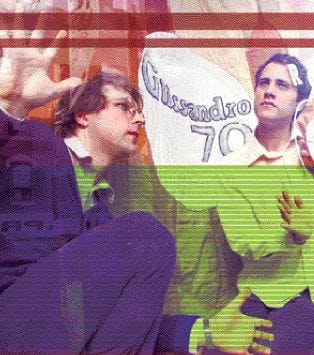
Location: Toronto diner Aunties & Uncles (RIP)
Album being promoted: Glissandro 70
The context: In a year where it feels like good news is not allowed to exist, one of the only bright spots is the recently announced and highly unexpected return of Glissandro 70, whose second album will arrive this May a mere 20 years after the duo of Sandro Perri and Craig Dunsmuir released their immaculate self-titled debut on Constellation. That record didn’t make much of a ripple outside of Toronto—which isn’t too surprising given that it was made by two publicity-shy studio rats with deep roots in the city’s underground improv scene. It also came out just before Perri completed his transformation from post-techno soundscaper into an internationally acclaimed singer/song-sculptor who just might be the only musician to share stages with both Philip Glass and Metronomy in the same week.
But Glissandro 70 was my favourite album of 2006, because it felt like the most 2006 album of 2006. At a time when indie-rock was splintering into myriad directions, Glissandro 70 seamlessly sewed up a lot of divergent threads: the ritualistic freak-folk abandon of Animal Collective; the neoclassical art-pop of Sufjan Stevens and Final Fantasy; the lo-fi trance grooves of Congrotronics; the West African guitar rhythms that would soon become NPR catnip; the post-DFA appreciation for early ‘80s disco-not-disco. (The album’s cover art and its epic closer “End West” pay tribute to pioneering New York dance label West End Records.) But for an album of largely free-form recording experiments, Glissandro 70 exuded a warm, welcoming vibe that embraced the idea of experimentation as a form of play. Silly and studious in equal measure, it’s a record that delivers transcendence with a smile. (My affinity for this record might also be tied up in the fact that the duo’s album-release show at the Tranzac Club was also the third-ever date I went on with my wife, so Perri and Dunsmuir aren’t the only duo marking a 20th-anniversary this month.)
This conversation with Glissandro 70 took place a week before that gig—which proved to be an extremely rare stage appearance for the two. As you’ll see in the Eye Weekly article reprinted below, the duo’s aversion to the formalities of live performance provides some prescient insight into why this project faded into the shadows for so long.
TORONTO, ON—It’s the first day of spring, and Craig Dunsmuir is probably the only person in the city marking the occasion by wearing a vintage Eric’s Trip t-shirt. But he does so not to express his fandom for the early-’90s Moncton indie-rock heroes. He wears the relic like an army vet wears a dog tag: as a reminder of a place he once was and doesn’t need to revisit again.
Dunsmuir once stood at the frontlines of Toronto’s early-’00s indie insurgence—a Wavelength regular who could be seen stage-rushing Constantines and Ninja High School shows, or playing bass for confrontational art-punks Currently In These United States. But he was equally fascinated by the experimental composers playing at the Music Gallery, or the Rat-Drifting label’s free-form nights at the Tranzac Club. His twin affinities for indie-rock formalism and improv inhibition manifested themselves in Dunsmuir’s Guitarkestra project, where he built abstract tracks by looping guitar patterns.
But then something funny happened on the way to avant-noise infamy—Dunsmuir wanted to dance. “Arthur Russell really blew my head off,” says Dunsmuir, referring to the late New York-based classical-cellist-cum-disco-super-producer. “In terms of bridging minimalism, modern composition, and disco—he was my gateway drug to dance music.”
And the man sitting next to Dunsmuir, Sandro Perri, is his pusher. Best known as electronic producer Polmo Polpo, Perri joined forces with Dunsmuir in the summer of 2003 for a project (hosted by Chicago-based blog Muted Tones) soliciting 10-minute compositions by newly introduced collaborators. Dunsmuir fed one of his Guitarkestra instrumentals through Perri’s studio circuitry and emerged with a gorgeously glimmering piece called “Something”; the duo christened the project Glissandro 70, a reference to both a nickname Perri received from producer Andy Magoffin, as well as Fela Kuti’s Afrika 70 band.
An edit of the track appears as the opening song on Glissandro 70’s new debut album, as a poignant reminder of the project’s humble origins. But what follows is some of the most raw, vibrant, and defiantly uncategorizable music to come out of this city in 2006.
With Perri spurring on Dunsmuir’s newfound interest in early Detroit techno and Chicago house, Glissandro 70 funks up what is perhaps the most rhythmically challenged of all musics—minimalist guitar composition—by locking its repetitive patterns to an incessant, invigorating dancefloor throb. Even tracks that don’t employ obvious club beats—like the devastating “Bolan Muppets,” which wraps a weepy T.Rex-ian “Metal Guru” harmony around an intensifying melancholic guitar line—adhere to dance music’s tension/release principles.
“Craig brings the skeletons and I help flesh them out,” Perri says. “As a producer, I tend to attract people who have good ideas but need someone to help them focus.”
Perri’s production is intimately lo-fi, like a pirate station picking up errant broadcasts of Detroit techno, Jamaican dub, New York disco and Nigerian Afrobeat. But like the “70” in their name, Glissandro 70 only references its inspirations in oblique terms, never succumbing to genre-hopping tourism; it’s ultimately folk music, rooted in both the indie and immigrant communities around them. However, Perri insists the album’s monstrous 13-minute closer “End West” is “not about the gentrification of Queen West,” though its traffic-jam ambience and sinister techno-dub pulse—punctuated by a mutated quote of Talking Heads’ “Pulled Up”—certainly feel like a night out at Queen and Beaconsfield.
“I probably enjoy listening to field recordings more than any other kind of music,” says Dunsmuir. “That might have something to do with there being a sort of temporality and geography imposed on the music.”
“Craig’s really good at distilling particular influences and making them his own,” says Perri. “Craig’s never been to Africa, but the first time I heard Guitarkestra, I immediately thought of [Nigerian] juju [music].”
Perri claims his own greatest contribution is that “I’m a good listener... it’s really important to be a good listener, not just in music, but in life.” However, while this ideal is crucial for creating, it conflicts with the act of performing. Unlike many creative partnerships, Glissandro 70 does not thrive on an introvert/extrovert dynamic—both Perri and Dunsmuir are more comfortable hiding out in the studio than playing on stage.
Says Dunsmuir, “A lot of people I’ve looked up to, like Brian Eno or Jim O’Rourke... their participation has been as much non-musical.”
“The name Glissandro 70 is Craig’s way of deflecting attention away from himself and putting it on me,” Perri laughs. “I empathize with how Craig feels being the focus onstage—but I’m not willing to take that role over.
“I really like that whole Bad Band Revolution idea,” adds Perri, referring to the localized movement (endorsed by Dunsmuir’s Ninja High School pals) promoting amateur adventurism over professional careerism. “It’s a reaction against that [traditional idea of live performance],” says Perri. “At the same time, it bothers me a bit because it still puts the focus on the performance aspect and becomes all about the process [of playing music]. But everything has a process, it’s just that not everybody makes it the thing to focus on. So I sometimes have a reaction when music becomes more about the visual/performing aspect, because people don’t cultivate enough of an opportunity to become better listeners.”
Considering Glissandro 70 are enlisting skilled players from the Rat-Drifting label stable for this Friday’s CD release show, do they feel the prevailing indie-rock culture in Toronto devalues musicianship? Dunsmuir replies: “The devaluing of musicianship for its own sake is not a bad thing...”
“But it’s unfortunate when it’s just a defensive reaction,” says Perri, “like, ‘This is something that needs to be destroyed!’”
But then, as Sonic Youth illustrated, any punk insurrectionist packing a “kill your idols” manifesto eventually develops chops anyway.
Says Perri: “You need chops to kill your idols!”
ENCORES
Glissandro 70’s second album, G70 2: Bones of Dundasa, arrives on May 1, though it’s a bit of a misnomer to call it their “new” record. It’s more like a savvy salvaging job: after finished recordings for a potential follow-up album were accidentally erased during a computer-system upgrade in 2016, Perri discovered a batch of rough mixes on another drive during a moment of COVID-lockdown housekeeping. Those tracks are bookended by a pair of novelties: a dreamlike cover of Arthur Russell’s “Lucky Cloud” with trombonist Peter Zummo and a rambunctious remix of the debut’s abstract T. Rex tribute “Bolan Muppets” courtesy of Montreal-reared/Berlin-based producer Dan Bodan:
Of course, the past 20 years have hardly been lacking for wonderful music from both members of Glissanrdo 70. Perri has released a handful of stellar records under his own name (including two I reviewed for Pitchfork) and with his electronic post-rock project Off World. Dunsmuir, meanwhile, currently leads the long-running 10-piece post-everything ensemble Dun-Dun Band, whose Bandcamp page overflows with spiritual-jazz splendour:
This is a free newsletter, but if you really like what you see, please consider a donation via paid subscription, or visit my PWYC tip jar!